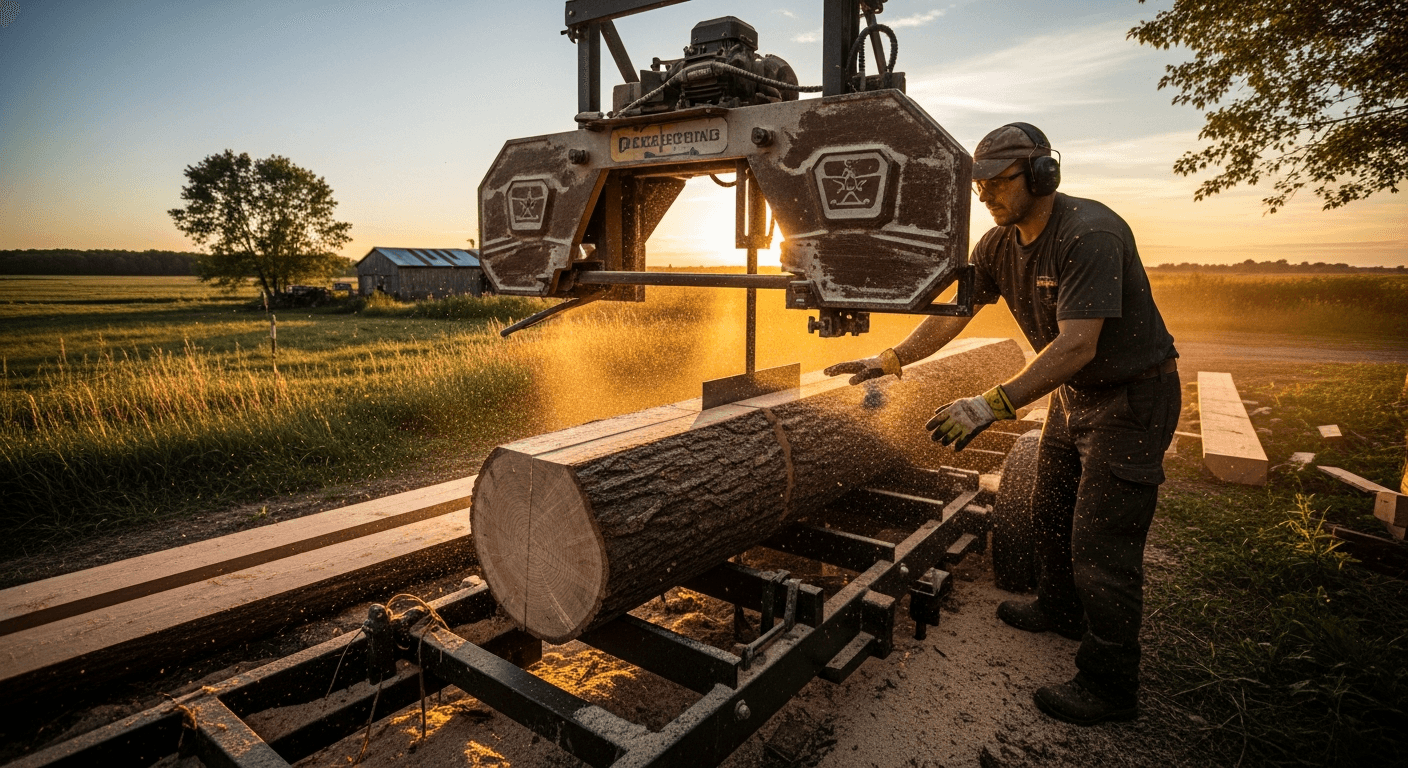
Whether you have logs from a fallen tree, cleared land, or purchased timber, custom milling turns raw logs into usable lumber. But how much does it actually cost?
The short answer: $0.25 to $1.00 per board foot, or $65 to $150 per hour, depending on the operator, your location, and the type of wood. Most jobs run $150 to $500 for a homeowner with a few logs.
Here is a detailed breakdown of every cost factor so you know what to expect before you hire a sawmill.
The Three Pricing Models
Sawmill operators typically charge in one of three ways. Understanding the differences helps you choose the right option for your situation.
1. Per board foot
This is the most common pricing model for portable sawmill services. You pay based on the volume of lumber produced.
| Wood Type | Price Per Board Foot | Notes |
|---|---|---|
| Softwoods (pine, spruce, fir) | $0.25 - $0.50 | Faster to cut, less blade wear |
| Common hardwoods (oak, maple, poplar) | $0.35 - $0.75 | Standard rate for most jobs |
| Premium hardwoods (walnut, cherry) | $0.50 - $1.00 | Harder on blades, more care required |
| Live edge slabs | $0.75 - $1.50 | Wider cuts, more setup time |
Best for: Large jobs with many logs. You only pay for what you get, and you can estimate costs in advance if you know roughly how many board feet your logs will yield.
2. Hourly rate
Some operators charge by the hour, especially for smaller or more complex jobs.
| Region | Hourly Rate |
|---|---|
| Rural areas / low cost of living | $50 - $85/hr |
| Suburban / mid-range | $75 - $120/hr |
| High cost of living areas | $100 - $150/hr |
Best for: Small jobs with just a few logs, or when you want mixed cuts (some boards, some slabs, some beams). Hourly rates include setup and breakdown time.
3. Lumber share
In a lumber share arrangement, the sawmill operator mills your logs for free and keeps a percentage of the lumber, typically 40% to 50%. You get the rest without paying cash.
Best for: Homeowners who have more logs than they need and do not want to pay out of pocket. The sawmill gets valuable inventory, and you get free lumber. This is more common with stationary mills than portable operators.
A 20-inch diameter red oak log, 10 feet long, yields roughly 80 to 120 board feet. At $0.50/bf, that is $40 to $60 in milling cost. The same lumber at retail prices would cost you $400 to $700 at a lumber yard. You save 85% to 90% by milling your own logs.
What Affects the Price
Log condition
Clean, straight logs with no metal are the cheapest to mill. Expect to pay more (or be turned away) for:
- Metal contamination: Nails, screws, and fence wire destroy saw blades. A single nail can cost $25 to $50 for a blade replacement. Most operators charge extra or refuse logs with known metal.
- Dirt and debris: Logs that have been dragged through dirt dull blades faster. Power wash or scrub the cutting zone if possible.
- Crooks and forks: Crooked logs are harder to set up on the mill and produce less usable lumber. Forked sections are usually cut for firewood instead.
- Decay: Partially rotted logs can still be milled, but expect lower yields and the operator may charge more for the extra handling.
Species and hardness
Harder woods wear saw blades faster and take longer to cut. Walnut and hard maple cost more to mill than pine or poplar. Exotic or unusually dense woods (like osage orange or ironwood) may carry a surcharge.
Cut type
- Through-and-through (plain sawn): Fastest and cheapest. The log is sliced straight through, producing a mix of flat and quarter sawn grain.
- Quarter sawn: The log is quartered first, then each quarter is sliced. Takes roughly twice as long as plain sawn, so expect higher cost.
- Live edge slabs: Wide cuts through the center of the log. Requires more setup and produces fewer board feet, so the per-BF cost is higher.
- Dimensional lumber: Cutting to specific dimensions (4x4 posts, 2x6 beams) adds setup time for each new dimension.
Travel and setup
Portable sawmill operators include travel and setup in their pricing, but long distances add cost:
- Most operators include travel up to 25 to 50 miles in their base rate
- Beyond that, expect $1 to $3 per mile surcharge
- Setup and breakdown typically takes 30 to 60 minutes and is included in hourly rates
- Some operators charge a flat trip/setup fee of $50 to $150 regardless of job size
Minimum charges
Almost every operator has a minimum charge, typically $100 to $250. If you only have one small log, you will pay the minimum regardless of board footage. This is why it makes sense to batch multiple logs into a single milling session.
Additional Services and Costs
| Service | Typical Cost | Notes |
|---|---|---|
| Kiln drying | $0.50 - $1.50/bf | Brings moisture down to 6-8% for indoor use |
| Planing / surfacing | $0.25 - $0.75/bf | Smooths rough-sawn boards to final thickness |
| Stacking and stickering | $25 - $75 | Proper stacking for air drying (some include free) |
| Log moving / loading | $50 - $150/hr | If operator needs to move heavy logs with equipment |
| Delivery | $50 - $200 | For stationary mills that deliver cut lumber |
Milling Your Own Logs vs Buying Retail Lumber
Is it actually cheaper to have your logs milled? Almost always yes, especially for hardwoods.
| Scenario | Your Cost | Retail Equivalent | Savings |
|---|---|---|---|
| 200 bf red oak, portable mill at $0.50/bf | $100 | $800 - $1,200 | 85-90% |
| 100 bf walnut, portable mill at $0.75/bf | $75 | $700 - $1,500 | 90-95% |
| 300 bf pine, portable mill at $0.30/bf | $90 | $300 - $600 | 70-85% |
The savings are dramatic for hardwoods. Pine and other commodity softwoods offer smaller margins since big box store prices are already competitive. But for any specialty wood, furniture-grade lumber, or live edge slabs, custom milling is significantly cheaper.
Questions to Ask Before Hiring
- What is your pricing model? (per BF, hourly, or lumber share)
- Do you have a minimum charge?
- Is travel included, and what is your service area?
- What is the maximum log diameter your mill can handle?
- Do you provide stacking and stickering?
- Do you offer kiln drying or can you recommend a kiln?
- What do I need to have ready before you arrive? (cleared area, limbed logs, etc.)
- Are you insured?
Frequently Asked Questions
Is it cheaper to mill your own lumber?
Yes, if you already have logs. Custom milling costs $0.25 to $1.00/bf. The same lumber at a lumber yard costs $3 to $15/bf depending on species. Even after paying for milling and drying, you save 70% to 95%.
How many board feet can a sawmill cut in a day?
A portable band mill typically produces 300 to 600 board feet per day with one operator. A commercial stationary mill with a crew can produce 2,000 to 5,000+ board feet per day.
Can I take my logs to a sawmill instead of having them come to me?
Yes. Many stationary sawmills accept customer logs. You will need a way to transport them (trailer, log truck, or ask the mill about pickup services). Stationary mills often have kiln drying and planing on site, which is convenient if you need finished lumber.
What is the minimum log size worth milling?
Generally, 10 inches in diameter at the small end and 6 feet long. Anything smaller produces very little usable lumber relative to the setup time. Most operators prefer logs 12 inches and up.
Find a Sawmill Near You
Ready to get your logs milled? Search our directory of 2,600+ sawmills, lumber yards, and portable milling services across all 50 states. Find operators near you, compare services, and contact them directly.